






Air Force Pilot Training Topics
- Typical Training Day in Pilot Training
- Life as an Officer in Undergraduate Pilot Training
- Euro-Nato Joint Jet Pilot Training (ENJJPT)
- Physical Fitness and the FACT
- Welcome Letter & What to Bring
- Acronyms & Terms Glossary
USAF Specialized Undergraduate Pilot Training (SUPT) Pipeline
AFROTC – Compete for Selection
- How to get an AFROTC Pilot Slot – Order of Merit score explained
- AFROTC PCSM Score – Information on the Pilot Candidate Selection Method
- Road to Wings – Differences between Active Duty, ANG, Air Force Reserves
- College Scholarships Guide – Search over 20 million scholarships and grants
Air Force Introductory Flight Screening (IFS)
- Air Force IFS offers 25 hours of flying training and 58 hours of ground training
- Read more about Air Force IFS in an online Blog
Academic Classes and Pre-Flight Training
- Aerospace Physiology, Altitude Chamber Rides + Test
- Ejection Seat / Egress Training, Parachute Landing Falls
- Aircraft Systems Class + Test
- Basic Instruments Class + Test
- Mission Planning / Navigation Class + Test
- Aviation Weather Class + Test
- Read about the Phase 1 Preflight & Academics Training
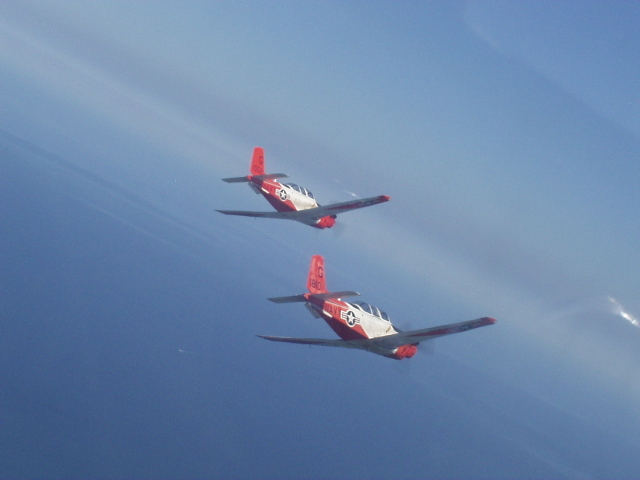
Primary Aircraft Training (T-6, T-34)
- Approximately 90 hours of flight training instruction, 22 weeks of training
- Purpose: teach students basic flying skills
- Focus: Contact, Instruments, Formation (2-ship), Navigation
- At the end of this 6-month phase, students pick which Advanced Track they wish to fly
- Students pick based on their performance / ranking in Phase 2
- Read about the Phase 2 Flight Syllabus
Track Selection Process – How do you pick which track you will pursue?
- Students request Track preference – you pick your Track, not your Aircraft
- Quota for each Track determined on a class by class basis – based on USAF needs
- Selection based on merit and instructor recommendation
- Students rank order based on: checkride scores, daily ride scores, academics, and flight commander assessment of military qualities (Commander’s Ranking)
- Wing Commander approves track placement
- The track that you select determines what type of aircraft you are assigned after UPT
Advanced Aircraft Training (T-38, T-1, C-12, T-44, UH-1)
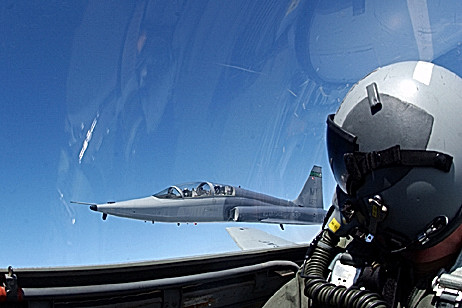
T-38 Talon – Fighter / Bomber Track
- Approximately 120 hours of flight instruction, 24 weeks of training
- Purpose: prepare graduates for fighter / bomber assignments
- Focus: Contact, Instruments, Formation (2/4 ship), Navigation, Low-level
- Graduates will pick follow on aircraft based on merit and instructor recommendation
- Graduates select F-22, F-16, F-15C, F-15E, A-10, B-1, B-52, B-2, UAV, FAIP, and are eligible for any Tanker, Transport, or Special Operations aircraft
T-1 Jayhawk – Airlift / Tanker Track
- Approximately 105 hours of flight instruction, 24 weeks of training
- Purpose: prepare graduates for airlift and tanker assignments
- Focus: Transition, Instruments, Navigation, Low-level, Formation
- All students receive basic airdrop / refueling training
- Graduates select C-5, C-17, C-130, KC-10, KC-135, RC-135, E-3, E-8, MC-12, U-28, NSAv, UAV, FAIP
- Read about the Phase 3 T-1 Syllabus
C-12 Huron / T-44 King Air – Multiengine Turboprop Track
- Approximately 115 hours of flight instruction, 26 weeks of joint training at NAS Corpus Christi, TX
- Purpose: prepare graduates for multiengine turboprop assignments (C-130, P-3, E-2/C-2, MV-22)
- Focus: Transition, Instruments, Navigation, Low-level, Formation
- USAF students receive specific C-130-tailored training – low level formation airdrop training
- Joint training for all USAF, USN, USMC, USCG, Foreign military pilots flying Turboprops & MV-22
- Graduates select C-130, MC-130, AC-130, EC-130, C-12, MC-12, U-28, NSAv, UAV
- Read about the Phase 3 T-44 / C-12 Syllabus
- Check out our T-44 and C-12 Study Guides
- Read our Aviator’s Guide to NAS Corpus Christi
UH-1H Huey – Helicopter Training
- Approximately 115 hours of flight instruction, 28 weeks of joint training at FT Rucker, AL
- Purpose: prepare graduates for USAF helicopter assignments
- Focus: Transition, Instruments, Navigation, Low-level, Formation, Remote Ops, NVG
- Joint training for all USAF and US Army helicopter pilots
- Graduates select UH-1, HH-60, CV-22, FAIP
Merit Assignment Selection System Process – How do you pick your aircraft?
- At completion of Phase-3 advanced training, students are rank ordered based on merit
- Flying, academic, and military performance scores
- Compete for aircraft compatible with their specialized tracks (i.e. fighter/bomber, airlift/tanker…)
- Numbers for each Major Weapon System (MWS) are determined by USAF needs
- Wing Commander approves assignment
- Graduates progress to follow-on FTU/RTU specific MWS training
- Students also attend Land Survival, Water Survival, and any other schools required at this time
The Path to Pilot Wings
All Air Force pilot candidates begin their flying training with introductory flight screening (IFS). Civilian flight instructors in Pueblo, Colorado administer the new flight screening program. Students fly the Mitsubishi Diamond DA-20 in their training. The program is a 40 day program that includes ground school and a 25 flight-hour flight screening course for up to 1700 students annually.
The next step in the process is joint specialized undergraduate pilot training, which prepares student pilots for the full spectrum of aircraft and flying missions. The term “Joint” denotes training with sister services such as the Navy, Marines, and Coast Guard.
 Pilot candidates then attend either Euro-NATO Joint Jet Pilot Training (ENJJPT) or joint specialized undergraduate pilot training (JSUPT). ENJJPT is located at Sheppard AFB, Texas. The entire course lasts about 54 weeks. Students learn with, and are taught by, U.S. Air Force officers and officers from various air forces of our European allies. Student pilots first fly the T-37 mastering contact, instrument, low-level and formation flying. Next, they strap on the supersonic T-38 and continue building the skills necessary to become a fighter pilot.
Joint specialized undergraduate pilot training began at Reese Air Force Base, Texas, in July 1992 following the arrival of the T-1A Jayhawk. Undergraduate pilot training continued training all students in the T-37B Tweet and T-38A Talon until the T-1A arrived at each pilot training base. JSUPT was completely in place after the last UPT class graduated at Columbus AFB, Miss., in 1997.
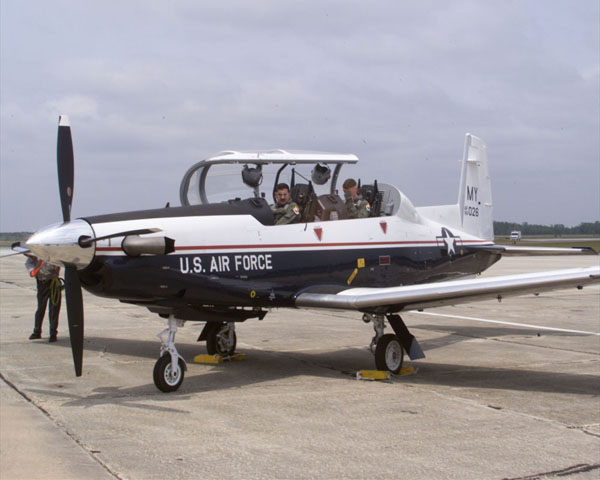
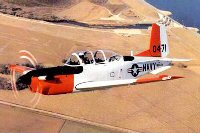 Military Pilot TrainingThe JSUPT program is accomplished through the cooperative efforts of the Air Force and the Navy. Joint training for Air Force and Navy students is conducted at Vance AFB, Okla., and Naval Air Station Whiting Field, Fla. Students complete primary flight training at these locations in the Air Force’s T-6 Texan II and Navy’s T-34 Turbomentor.
Other students complete the primary training at Columbus AFB, Miss., or Laughlin AFB, Texas, flying the T-6 Texan II. The USAF was first to phase in the T-6 as a replacement to the (now retired) T-37 Tweet. The first base to transition was Moody AFB, GA (no longer a UPT base) and the last base to transition was the ENJJPT program at Sheppard AFB, TX.
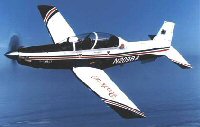 Following the primary phase of JSUPT, students move on to advanced training in one of several tracks. Students selected for fighter-bomber assignments fly the T-38A, concentrating on low-level tactics, instrument procedures, 2- and 4-ship formation flying and navigation training.
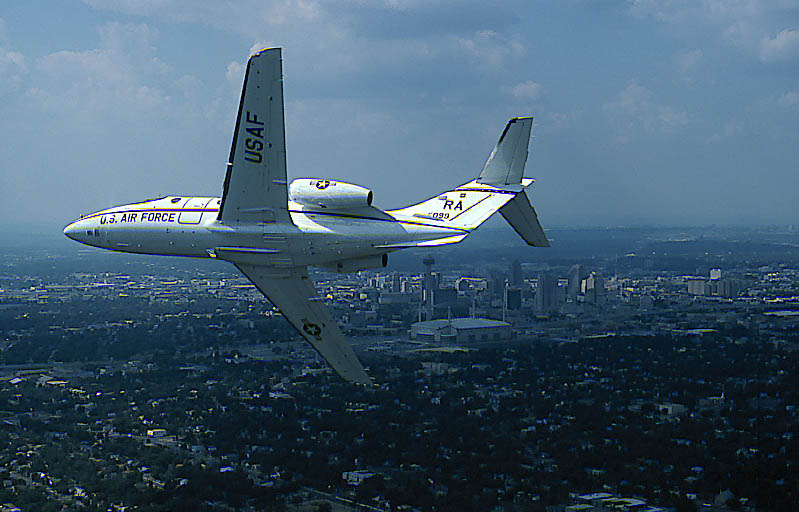
Prospective airlift and tanker pilots complete their advanced training in the T-1A at Columbus AFB, Miss., Laughlin AFB, Texas, and Vance AFB, Okla., where they are introduced to crew resource management techniques, air-to-air refueling, airdrop missions and radar positioning and navigation.
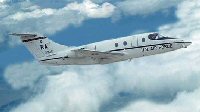 Students selected for the multi-engine turboprop track will eventually fly the C-130 Hercules and train at Naval Air Station Corpus Christi, Texas, in the T-44 or C-12 turboprop trainer. The training profiles closely resemble typical missions flown by the C-130.
Other students are selected to fly helicopters and complete their advanced training at Fort Rucker, Ala., in the UH-1 Huey. The helicopter syllabus includes operational skills such as low-level flying and combat tactics training.
Academic and Military Training
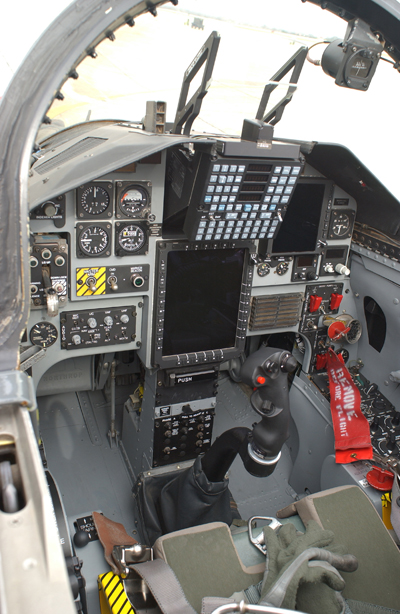
When student pilots are not flying or in simulators, much of their duty day is taken up with academic classes, officer development, self-study and physical conditioning.
Academics include conventional classes where contractor and active-duty military serve as instructors. Additionally, classroom instruction is augmented by computer-assisted instruction (CAI).
Officer development topics include Air Force doctrine, rated officer duties, flying assignments, and perspectives of senior noncommissioned officers and senior officers.
Graduation
The JSUPT program lasts approximately 52 weeks. After successfully completing JSUPT, officers receive their silver wings and are awarded the aeronautical rating of pilot. They attend follow-on training in their assigned aircraft at various bases known as Formal Training Units (FTUs) around the country.
Nineteenth Air Force also provides follow-on training for most Air Force pilots in their assigned aircraft. Pilots assigned to fighter aircraft complete the introduction to fighter fundamentals course at Randolph AFB or Sheppard AFB, Texas, or Moody AFB, Ga., flying the AT-38B, and then move on to train in either the F-15 Eagle at Tyndall AFB, Fla., the F-15E Strike Eagle at Seymour-Johnson AFB, NC., or the F-16 Fighting Falcon at Luke AFB, Ariz. Altus AFB, Okla., hosts training for pilots assigned to the KC-135 Stratotanker and C-17 Globemaster III aircraft. The C-5 training center has moved from Altus to Lackland AFB, TX. Aircrews assigned to fly the C-130 train at Little Rock AFB, Ark. or Dobbins ARB, GA, and pilots assigned to fly MC-130 Combat Talon, HC-130 aircraft, UH-1N, HH-60 Pave Hawk, and CV-22 Osprey pilots receive their training at Kirtland AFB, N.M. Keesler AFB, Miss., provides training for pilots assigned to the C-21. A schoolhouse is being stood-up at Canon AFB, NM for the NSAv fleet and the U-28 schoolhouse is at Hurlburt Field, FL. The new MC-12 schoolhouse (MQT course) is in Meridian, MS, preceded by a simulator course for IQT.


