
Ranger Indoctrination Program
For those soldiers who would like to be part of the elite specially trained unit called the Army Rangers, there is much to be considered. Preparation to be a Ranger takes more than just sheer determination. In addition to physical strength, resilience and grit, it demands mental fortitude. Once a soldier has made it through the first phases of training, which includes nine weeks of boot camp, several more weeks of Advanced Individual Training and three weeks of Army Airborne School, he is assigned to the 75th Ranger Regiment and is ready to begin the US Army Ranger Indoctrination Program and eventually Army Ranger School.
The Army Indoctrination program, which is also known as Ranger Regiment, begins immediately after graduating from Army Airborne School, and consists of four weeks of rigorous physical and academic training. Physical training includes among other things, the five mile run, road marches, rope training and a water survival test. Additional training includes map reading and navigation, Ranger history, airborne operation and standards, and combat life saver certification. Ranger Regiment is all about selecting soldiers who have what it takes to be Army Rangers.
Ranger School
Those soldiers who make it through Ranger Regiment are then sent to either the 75th Ranger Regiment Headquarters or one of three Ranger Battalions, and once they are proven ready, they move on to Ranger School. Ranger School is mentally and physically draining and prepares the soldier for battle by placing him in situations very similar to true combat. A normal day in Ranger School is typically 20 hours of grueling training with an average of 3 1/2 hours sleep. During different phases of the training soldiers often have to go for over 24 hours without sleeping. Not only are Ranger students sleep deprived, they also are expected to subsist on two meals a day or less. These perspective Rangers also conduct much of their training carrying 65-90 lbs of equipment on their backs. Ranger School is broken up into three phases, which are called Benning Phase, Mountain Phase and Florida Phase.
Benning (Crawl Phase)
The Benning Phase, so named for its location at Camp Darby, Fort Benning, Georgia is the most physical phase and lasts for 20 days. The first week, known as Ranger Assessment Phase (RAP) is crucial in the selection process. RAP week events include combat water survival, land navigation, a six hour 15.5 mile march and the Ranger physical fitness test. The Ranger Physical Fitness Test consists of a five mile run in 40 minutes or less, at least 49 push-ups, 59 sit-ups and a minimum of 6 chin-ups. In order to pass the test the soldier must score at least 70 points in each event. Each soldier is tested in the 17 to 21 year old range no matter what his actual age. Other activities in the Benning phase are obstacle courses, ambush and combat training, reconnaissance patrols and airborne operations.
Mountain (Walk Phase)
The Mountain Phase, which takes place at Camp Merrill, in the Georgia mountains, also lasts for a period of 20 days and teaches survival techniques in the hostile conditions of the mountains. Dealing with extreme sleep deprivation, hunger and emotional stress are a key part of this phase of training.
Florida (Run Phase)
The Florida Phase is a 16 day phase which tests leadership skills. It involves survival skills in swamps and jungle-like surroundings and takes place at Camp Rudder, Eglin Air Force Base, Florida. The soldier learns small boat, ship-to-shore and stream-crossing operations.
Preparing for Ranger School
Over 50 percent of soldiers who make it as far as Ranger School do not make it through to the end of the program and 60 percent of those soldiers, wash out within the first week. This high rate is often because of lack of physical preparation on the part of the soldiers. There are many ways to prepare physically for the rigors of Ranger School. First of all it is important to know exactly what will be expected and train for it in advance. Daily push-ups, chin-ups and sit-ups are highly recommended. Be able to do over and above what will be required in Ranger School. Run five miles 3-4 times a week until the two mile run can be accomplished in 13 minutes and the 5 mile run in 35 minutes. Swim 2-3 times a week while wearing a uniform. Walking fast, while carrying a fifty pound rucksack is also highly recommended. Last but not least, it is advisable to try to gain 5-10 lbs before beginning training, as candidates always lose weight in Ranger School.
Ranger school has been called the “toughest combat course in the world”, but for those who are up to the challenge, and are ready to push themselves beyond their limits, the reward of being a part of this select group of warriors called the Army Rangers, is worth the monumental effort. Army Ranger School Activities
- Daily Physical Training Army Rangers
- Ranger History test
- Map Reading
- APFT
- Airborne Operation
- Ranger Standards
- Day and night land navigation
- 5-mile run
- Combatives
- Knots
- Combat Water Survival Test
- 6, 8 and 10-mile road marches
- Driver Training (DDC Card)
- Fast Rope Training
- Combat Lifesaver certification
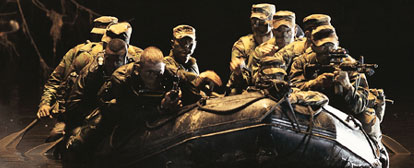
Ranger Preparation – Physical Training
Check out the Army Special Forces Workout to help prepare for the rigors of Ranger School and read more below for additional training tips and techniques.
Exercise Menu and Schedule – Prepared by MSG House of the Army Physical Fitness School
The Ranger student will be challenged physically during the following 7 events:
Check out our new section on Air Force Special Operations.
- APFT
- 5 Mile Run
- 16 Mile Road March
- Land Navigation
- Pull-ups
- 3.2 Mile Buddy Run
- Other: This area includes those daily events such as running or rucking between training sites and the occasional motivational conditioning exercises.
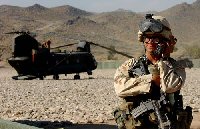 The APFT is administered to the standard as depicted in FM 21-20, to the letter. The event consists of the push-up, sit-up, and two mile run. Regardless of age the student will be tested in the 17 to 21 year old age bracket, and you must score 70 points per event. This means 49 push-ups, 59 sit-ups, and 15:12 on the run, as a minimum, must be achieved. The prospective Ranger student should be able to score 100 points per event the APFT. You should conduct a “to standard APFT” being graded by someone other then a member of the unit or your buddy, the key is to have the grader give you an honest assessment that you can use as a starting point. If you cannot score well on the test then the unit should stop you at home station.
The following is an exercise menu that will assist the perspective Ranger student to prepare for the course:
- Timed sets of push-ups – Do timed sets of Regular, Wide arm and, Diamond push-ups for 40-30-20 seconds each with no more then 30 seconds rest between sets. Adhere strictly to proper form described in FM 21-20. (3 sets minimum)
- Bench press – Strength improvement. Perform 20 repetitions of 50% of body weight working towards 20 reps at 65%. Do 3-4 sets per session.
- Front Deltoid raises – 10-15 pounds 3-4 sets working towards temporary muscle failure (TMF).
- Tricep Extension – 10-15 pounds 3-4 sets working towards temporary muscle failure (TMF).
- Seated or bent over row – Strength improvement. Perform 20 repetitions of 50% of body weight working towards 20 reps at 65%. Do 3-4 sets per session.
- Swimmer or Prone Row – 3-4 sets at 20-30 reps each.
- Roman chair – 3-4 sets 20 –30 reps per set, facing down, progressing to with weight.
- Dips- 3-4 sets working towards muscle failure.
Need help? Check out our Push Ups Improvement Section
THE SIT-UP
- Timed sets of sit-ups- Do timed sets of sit-ups for 60-40-30 seconds each with no more then 30 seconds rest between sets. Adhere strictly to proper form described in FM 21-20. (3 sets minimum)
- Flutter kicks – 3 sets of 50 –100 reps.
- Hanging leg raises* – 3 sets of 50 – 100 reps. Start with legs bent work towards legs straight.
- Incline sit-ups* 3-4 sets of 30 to 50 progressing to with weight as strength improves.
- Flat bench leg raises* – 3-4 sets of 20 to 30.
*Exercise should be done very slowly to ensure a contraction is maintained throughout the repetition.
THE 2 MILE RUN
Intervals are the best way to improve on your 2 mile run time. See Fm 21-20 or the unit MFT for the proper method of conducting interval training. Interval training should not be conducted more then one day per week.
THE 5 MILE RUN
In order for the prospective Ranger student to adequately prepare for this event, a very through warm-up should occur prior to conducting the 5 mile run to the standard of 8 minuets per mile plus or minus 15 seconds (39:45 to 40:15). This should include stretching, rotation drills and, calisthenics session with sufficient intensity to produce TMF in a moderately fit soldier.
- Interval training – Should be conducted no more then once per week and for a distance of at least 8 work laps at 400 yards each.
- Fartlek run – Twice per week at 3-5 miles per run. Heart rate should not drop lower then 70% training heart rate (THR) and no higher the 90% THR.
- Long slow run – 6-8 mile run with the pace never dropping slower then 8 minuet miles.
THE 16 MILE ROAD MARCH
The 16-mile road march is conducted with all combat equipment that the Ranger student will be issued plus weapon. The pace is no faster then 17min per mile and no slower then 24min per mile. Prepare for this event by conducting a 4-mile road march with at least 40 pounds of equipment plus water and rubber duck at least once a week. Each week add 2 miles to the total until you arrive at 16 to 18 miles to standard. You can road march more then once per week but remember that this event is long and boring, don’t waste valuable training time on something as easy as road marching.
LANDNAV
Perform landnav training on a course that you create or one that is already in place on your post. The course should be at least 10 kilometers in length; you should be able to begin in the dark or at night and move through to daylight. Your equipment will be LCE with rubber duck.
PULL-UPS
The pull-up event is done following the APFT and you must complete at least 6 pull-ups to enter the course. The start position is mount the bar and come to a motionless hang on the bar with palms facing towards body arms extended overhead. On the command GO you will begin by pulling your body up to a motionless pause with the chin over the top of the bar then lower the body down to the start position. This is one repetition, remember that you will not be allowed to swing or other wise use your legs to assist your movement.
Begin your training by conducting an assessment of your current ability. Following your assessment begin training for improvement by using one or all of the following methods:
- 3 sets of assessment total. Have a spotter available to assist you by lifting on the legs as you attempt to execute the pull-ups.
- Lat pull down. 3 sets at 50% body weight 8-12 reps per.
- 3-4 sets on the gravitron.
THE SWIM
If you can swim, good you should practice swimming at least 20 meters with LCE and weapon while in BDU’s. You should also practice walking off the 3 meter board with LCE and weapon while wearing BDU’s. You will have to enter the water surface with dropping your weapon. The final swim event is the equipment removal station. You should practice entering the water from the side of a pool. You will wear the same uniform as stated above. You will remove your LCE and release your weapon while remaining submerged. Once the equipment is removed you will surface and swim to the side of the pool.
NOTE: All swim events must be accomplished without showing fear. If you can’t, learn how!
Want to challenge yourself? Check out the Army Special Forces Workout to prepare you for Ranger School.
Ranger Combat Gear
MultiCam Gear

Condor Tactical Cap with Velcro Patch

Under Armour Tactical
Ranger School – No Excuse Leadership
 A great compilation of U.S. Army Ranger School vignettes designed to demonstrate how one can achieve the mental toughness to succeed…no matter what the adversity. Though exceptionally diverse in background and experience, the Ranger students chronicled in this book reveal that they all had one thing in common…tenacity, perseverance and a desire to be one of the best. RANGER SCHOOL, NO EXCUSE LEADERSHIP is an excellent addition to any leadership or business manager development program and should become as worn, tabbed and dog eared as any well read ‘-10’ equipment maintenance manual. Rangers Lead The Way!
Special Operations in Iraq
 This sensational book reveals the true and compelling story of the Special Force units of the Coalition, such as the SAS, SBS and Delta Force who worked in the shadows, often unseen, unheard and unsung. It describes their missions behind the lines from the early days, well before hostilities opened formally. It was an open secret that groups were deployed probably operating in the western desert against Saddam’s forces and the Scud missile threat. What was actually going on is revealed here and until now their roles and actions have not been described in any detail.
These are thrilling tales of incredible daring and endurance told by men whose courage and military skills are inspiring. The book also covers operations such as the spectacular rescue of POW Private Lynch and the secret operations to target Saddam and other leaders of his regime of terror.
Among Warriors in Iraq
 Join Big Hungry, Kentucky Rife, Serpico and Jedi Knight for a harrowing journey into the heart of the Iraqi insurgency. A former Marine infantryman, Tucker follows the warriors of the 101st Airborne Division in Mosul and the 82nd Airborne and 10th Mountain Divisions in Fallujah during 19 weeks of urban warfare in late 2003 and early 2004. In declaratives one might describe as debased Hemingway on speed, Tucker tags along for counter-IED (improvised explosive devices) patrols and zero-dark-30 (predawn) raids, capturing the adrenaline-laced urgency of urban combat against a hidden enemy. His conversations with troopers are refreshingly authentic; his analysis of the politics of Iraq tends toward open advocacy for the Kurds and a separate state of Kurdistan. (Tucker is the author of Hell Is Over: Voices of the Kurds After Saddam.) But his gritty firsthand account is packed with detail: from the slow ballet of “scoping roof tops and alley corners,” the excruciating tension of disarming IEDs and the frenetic choreography of urban combat to the children who are never far away and are always quick with a smile, a wave and an enthusiastic “Amerikee!” Several impressive accounts of the second Iraq War have appeared already from embedded journalists, but few are as personal and edgy as Tucker’s.
Lone Survivor
 Four US Navy SEALS departed one clear night in early July, 2005 for the mountainous Afghanistan-Pakistan border for a reconnaissance mission. Their task was to document the activity of an al Qaeda leader rumored to have a small army in a Taliban stronghold. Five days later, only one of those Navy SEALS made it out alive.
This is the story of the only survivor of Operation Redwing, US Navy SEAL Petty Officer Marcus Luttrell, and the extraordinary firefight that led to the largest loss of life in American Navy SEAL history. Lt. Michael P. Murphy led the team of PO2 Luttrell, PO2 Dietz and PO2 Axelso. Luttrell fought valiantly beside his teammates until he was the only one left alive, blasted by an RPG into a place where his pursuers could not find him. Over the next four days, terribly injured and presumed dead, Luttrell crawled for miles through the mountains and was taken in by sympathetic villagers who risked their lives to keep him safe from surrounding Taliban warriors.
Masters of Chaos
 The wars in Afghanistan and Iraq have given the U.S. Army’s Special Forces, also known as the Green Berets, a central role in American military action like never before. Several hundred U.S. Special Forces operators helped a motley band of Afghan rebels orchestrate a stunning rout when they overthrew the Taliban after 9/11. In Iraq, as journalist Linda Robinson explains in Masters of Chaos: The Secret History of the Special Forces, Special Forces units were the main U.S. elements on the ground in the northern and western regions of the country, where they defeated government forces that outnumbered them many times over. Robinson tells the story of the Special Forces through the eyes of a few of its more colorful personalities, men with call signs like Rawhide and Killer. She follows them around the world from Panama and El Salvador to Somalia, Kosovo, and, finally, Afghanistan and Iraq. Surprisingly, however, she devotes only a few pages to the Green Beret-led victory in Afghanistan, even though it was arguably their greatest achievement since they were created after World War II.
Ranger School

Inside The Delta Force

The Special Ops Workout

Army Officer’s Guide

Ranger Handbook

US Special Forces Guide

Ranger Black and Gold

Six Silent Men

Black Hawk Down

Rangers No Excuse Leadserhip

Ranger Workout Video


